






Three trays on one gold post
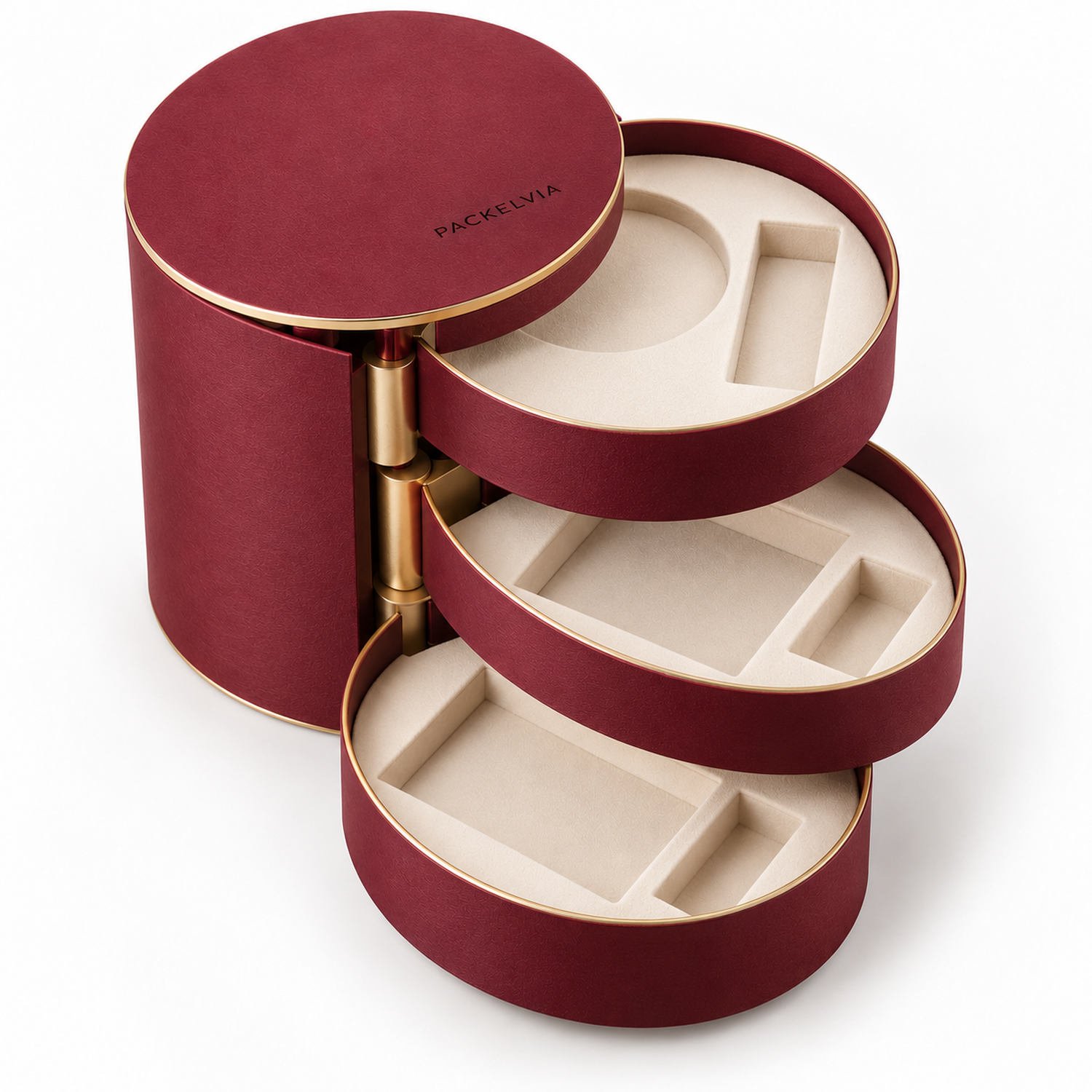
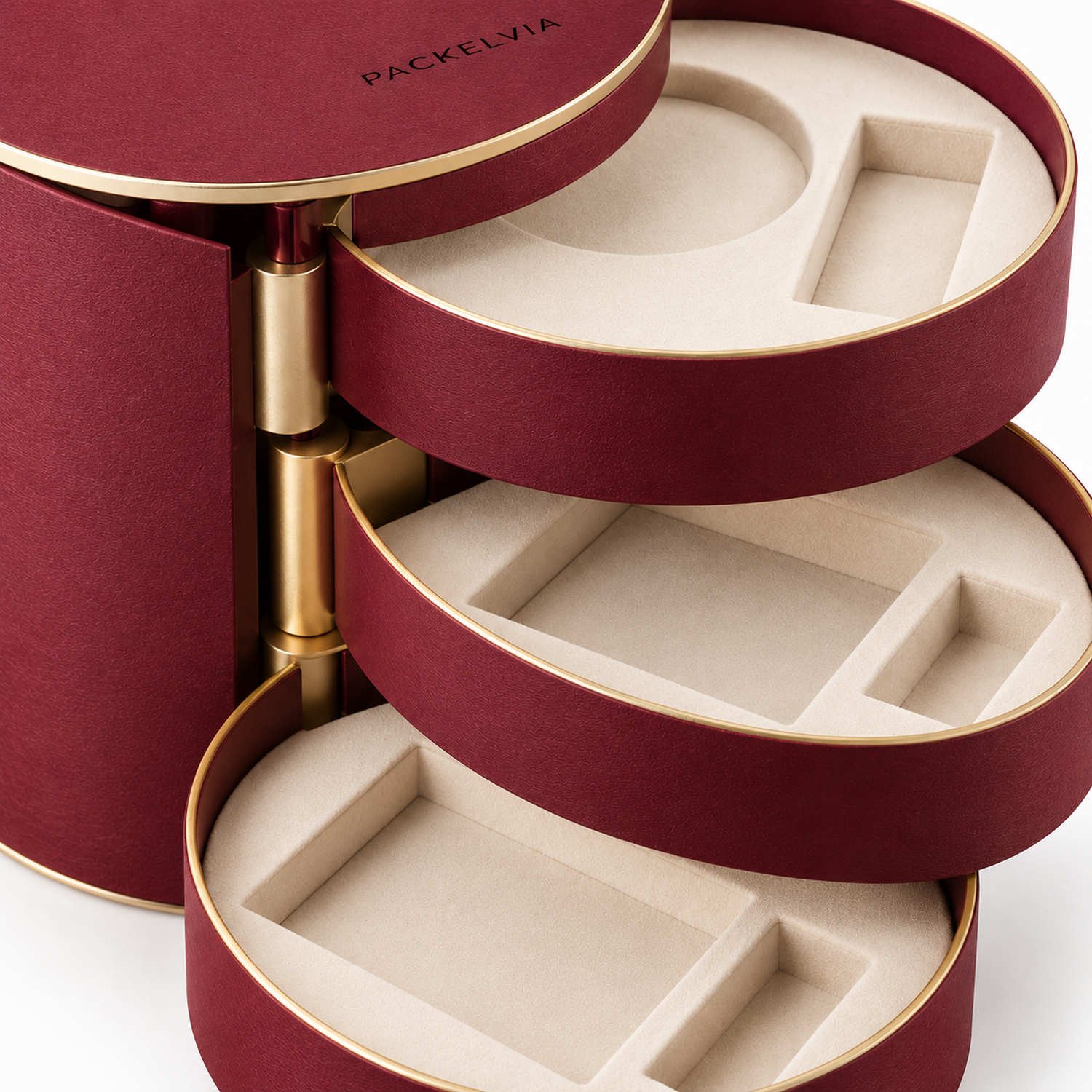
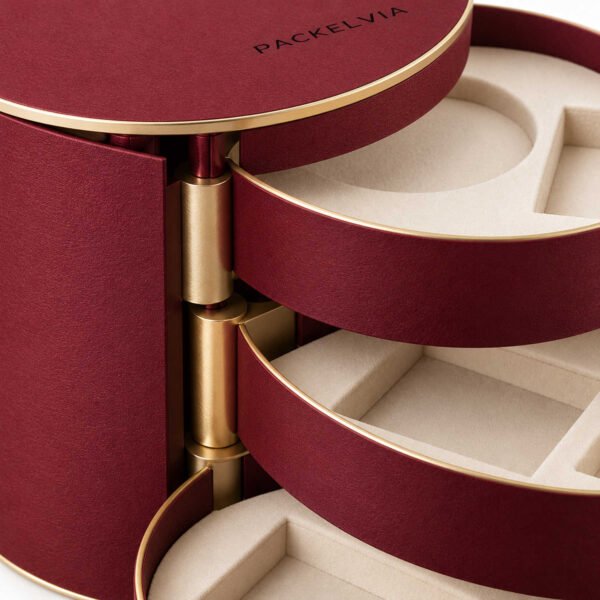
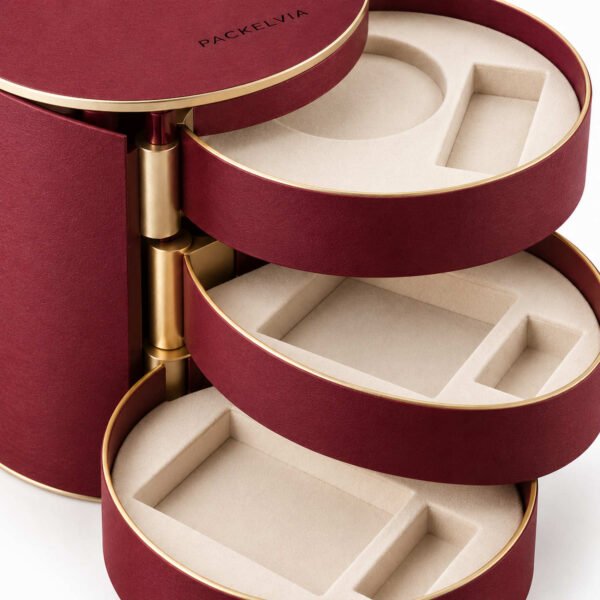
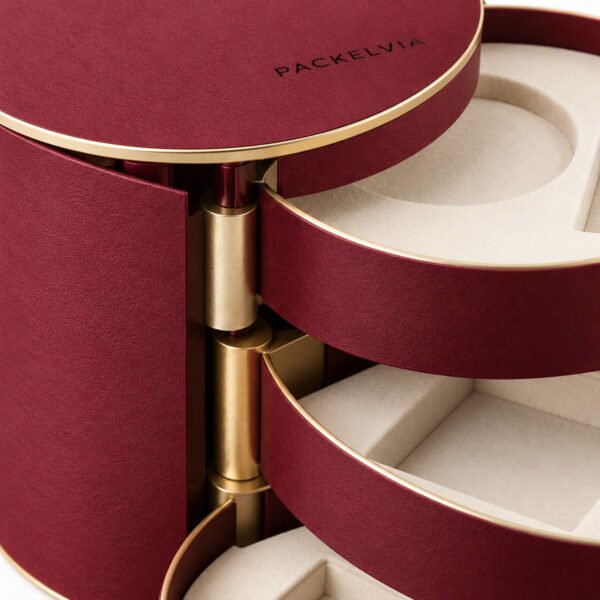
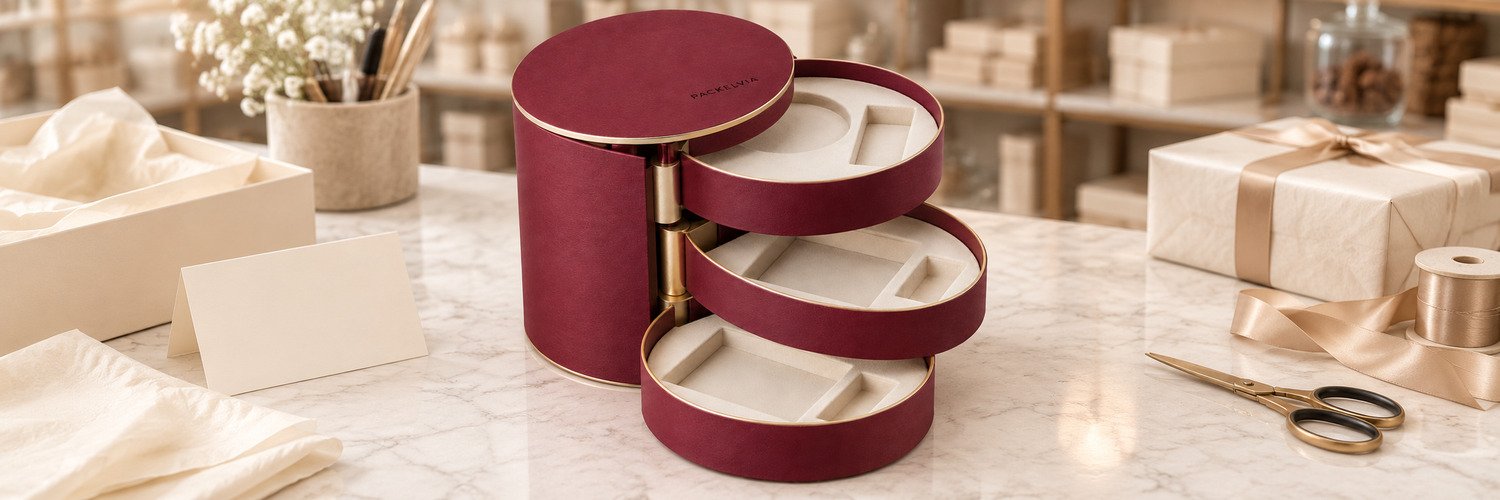
A burgundy drum, a gold-tone post up the middle, three shallow trays hooked onto it at three heights. Each tray is a wedge of the drum: it has its own curved wall, its own rim, and its own cream interior with shaped recesses.
Swing them all out and you have a staircase. Swing them in and the three curved walls line up with the body — the drum closes.
It opens like a fan, not like drawers
Drawers slide and need rails and clearance. These trays rotate on one pivot, so nothing rubs along a track and nothing has to be perfectly parallel — the tray swings, and the pivot sets the only tolerance that matters.
It also changes the gesture. A drawer is pulled towards you; a tray is turned, and turning is what makes someone keep going past the first one.

Closed, it reads as one drum
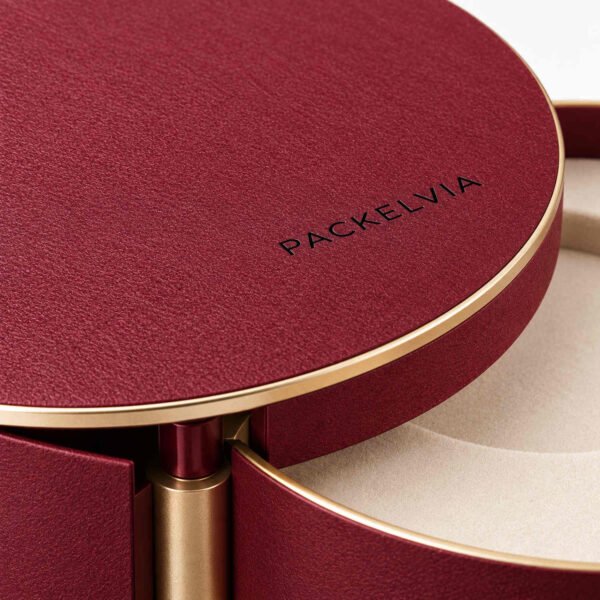
The three trays are not stacked inside a box — they are the box. Their curved walls are segments of the same circle, so when they are pushed home, the outside is one continuous burgundy surface with a gold-tone line at the joints.
That is the whole trick of this format: on a shelf it looks like a sealed cylinder, and it only reveals that it has three levels when someone turns the first tray.
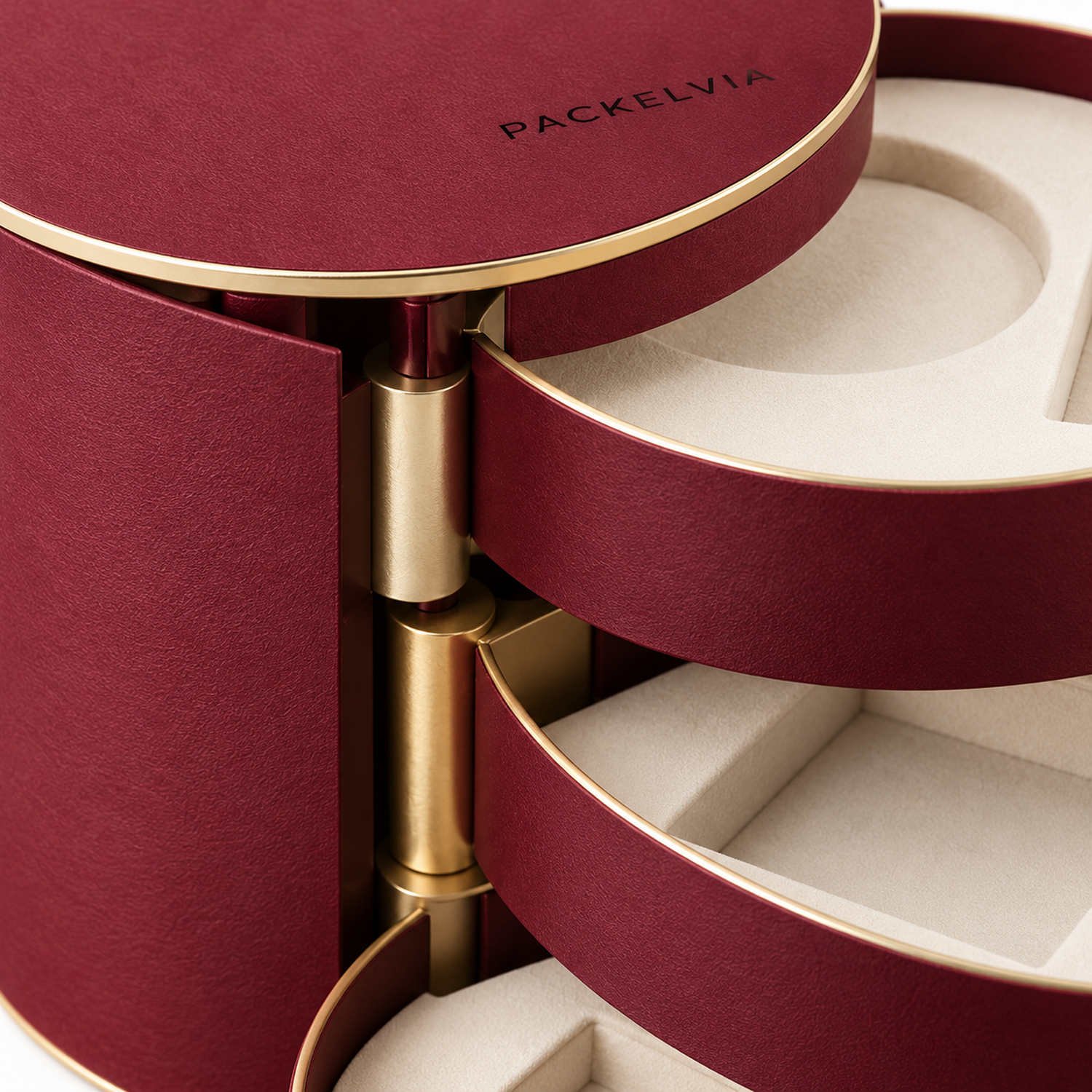
The post carries all three
This is the part that decides whether the box survives its first week. In a drawer box, the weight sits on a base panel; here every tray hangs off one post, so the post is the entire load path, and it has to stay straight under three loaded trays, not one.
Two tolerances govern the result. The first is the layer spacing: each tray needs a collar that fixes its height, because a tray that sits a millimetre low touches the one beneath it when it swings. The second is the curved wall: three segment walls must land on the same diameter as the body, or the closed drum shows a step — and on a matte burgundy wrap, a step is the first thing a buyer sees.
Cream compartments, shaped to the pieces
The interior is not a flat pad with elastic. Each tray carries a cream insert with recessed pockets, and the pocket shapes are cut or formed per layout, so the ring sits in the ring pocket and the chain sits in the channel instead of the pieces sliding across one another.
Because the pockets are recessed rather than raised, the pieces sit below the tray rim, which means the tray can swing shut without the contents being clipped by the wall above it.
Printed on the curve
Your diameter, tray count, layer heights, burgundy and logo. The outside is a wrapped curve, not three flat panels, so artwork is checked as a wrap: a straight rule drawn on a flat file arrives as an arc, and a logo placed near a joint gets split by the seam.
The trays and the body are cut on dies you own, so the segments match by tooling rather than by hand.

It arrives closed
A pivot box has one failure mode a drawer box does not: it can open by itself. Three trays are free to swing, and in a carton that means three impacts on the post instead of one still box.
So the trays travel locked shut — banded or blocked inside the carton — and the carton carries a fitment that keeps the drum from rolling. The post is a point load, so it gets supported, not just surrounded by empty space.
Packaging reference: ISTA test procedures for packaged products.
Gift box sizes and specifications
| Brand | Packelvia |
|---|---|
| Reference | PK-GF-04 |
| Format | Spiral tier gift box, pivoting trays on a central post |
| Visible structure | Cylindrical burgundy body, three burgundy trays at different heights |
| Opening | Trays rotate on a central post; when closed, they complete the drum |
| Reference colours | Burgundy and cream with gold-tone rims and post |
| Interior | Cream fitted insert with recessed pockets, one per tray |
| Tray count | Three shown; two or four subject to post height and clearance |
| Layer spacing | Fixed by collars on the post; confirmed on sample |
| Pocket layout | Cut to your product dimensions; to be confirmed |
| Dimensions | To be confirmed against your product |
| Board and paper grade | Confirmed on approved sample |
| Post material and finish | Confirmed on sample |
| Packing method | Trays locked shut, carton fitment to prevent rolling, agreed per project |
| Printing | Logo wrapped to the curve; finish confirmed per order |
| Minimum order | 500 boxes |
| Sample | Available on request; timing confirmed per project |
| Supply scope | Packaging only; displayed contents are illustrative |
Samples, season slots, and the next step
Start with one box, not a carton. Send the piece dimensions and how you want them split across three trays; the sample arrives assembled so you can turn each tray and feel whether the middle one rubs. That turn tells you more than any render — it is the only version of this box that can fail.
Two things move faster than most people expect: a new die, and the weeks before a gifting season. Put the diameter and the date you need to be on the shelf in the same message. We will tell you today whether that slot is open, and if it is not, we will say so instead of taking the order.
Gift packaging questions
Are the contents included?
No. This is a packaging listing; the jewellery and gifts shown are illustrative and are not shipped with the box.
Can the pockets be shaped to my pieces?
Yes. The insert is cut per layout, so rings, earrings, chains and small accessories can each get their own recess instead of sharing one flat pad.
Does a tray stay where you leave it?
That is a question for the pivot, not the paper — friction and any stops are set on the post and confirmed on the sample. Tell us if you need it to hold at an angle while a customer looks.
Can I have two trays, or four?
Yes, within limits: each tray needs its own collar and clearance, so adding one changes the post height while the closed diameter stays the same. Send the assortment and we will say what fits.
Can the interior be a different colour?
Yes. Cream is what the reference shows; a darker interior is usually chosen for silver, a lighter one for gold and gemstones.
Is there a 500-box minimum?
Yes, with or without printing. Sample and production timing depend on the dies, the post and finishing, so dates are confirmed per project — send the spec and the date you need, and we will reply with actual dates.