


Product description
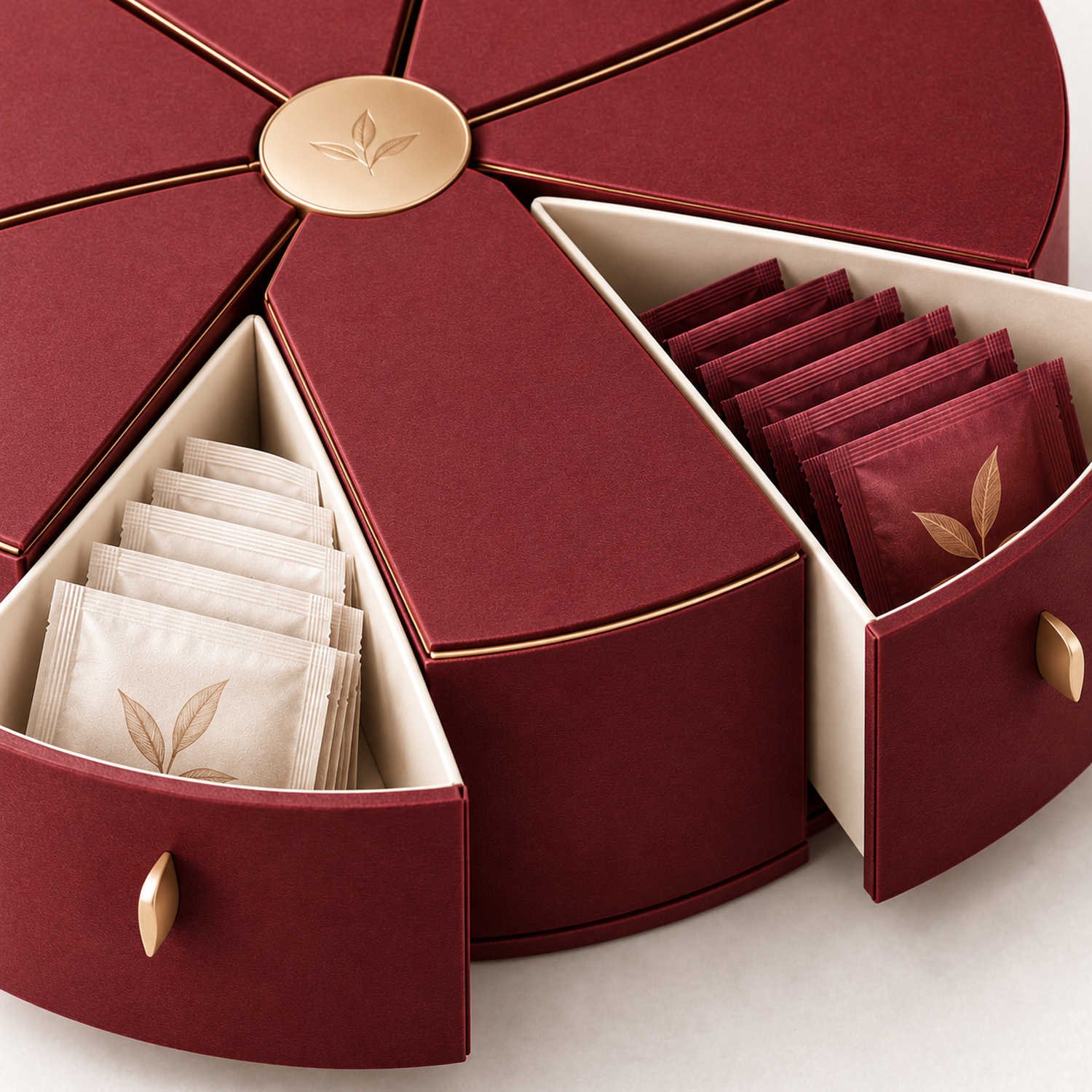
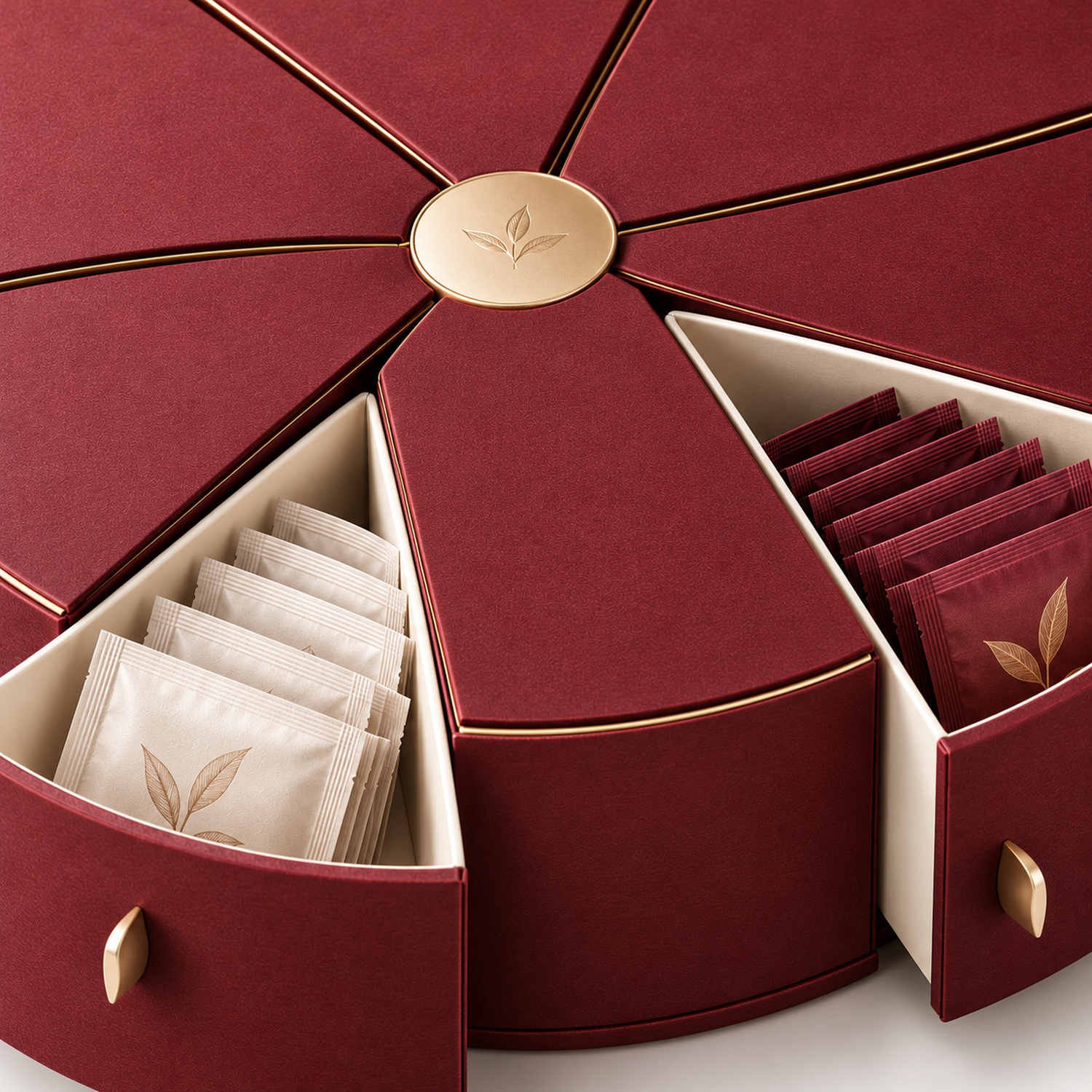
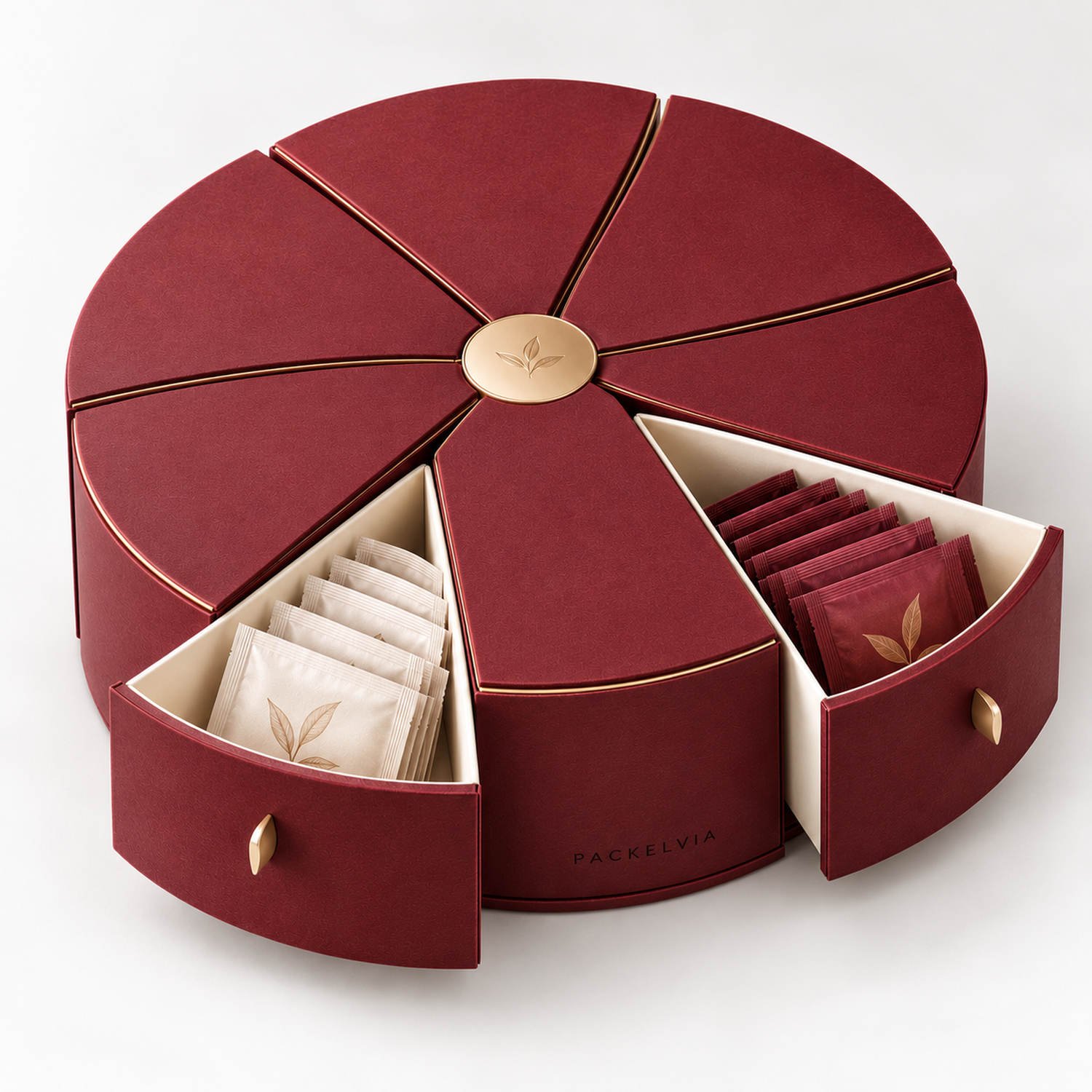
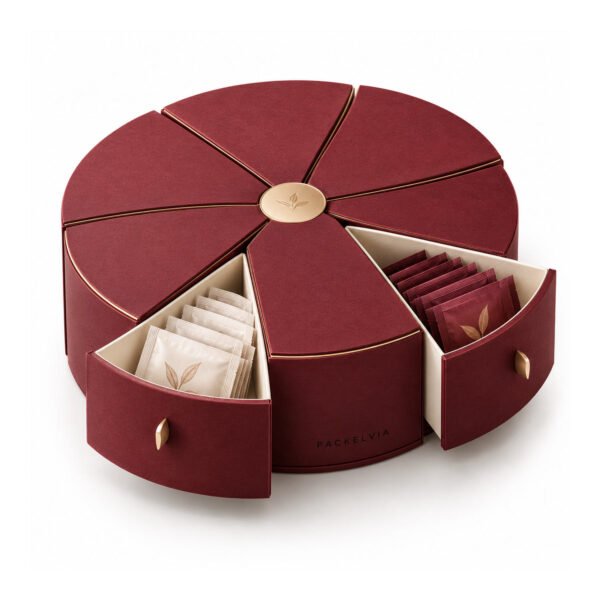
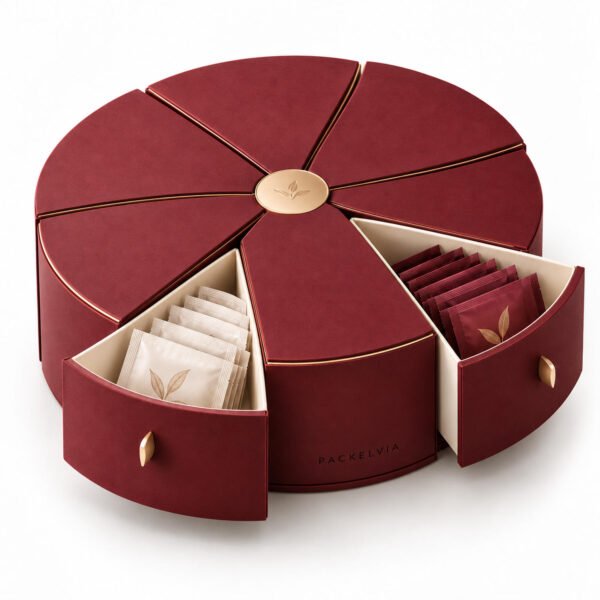
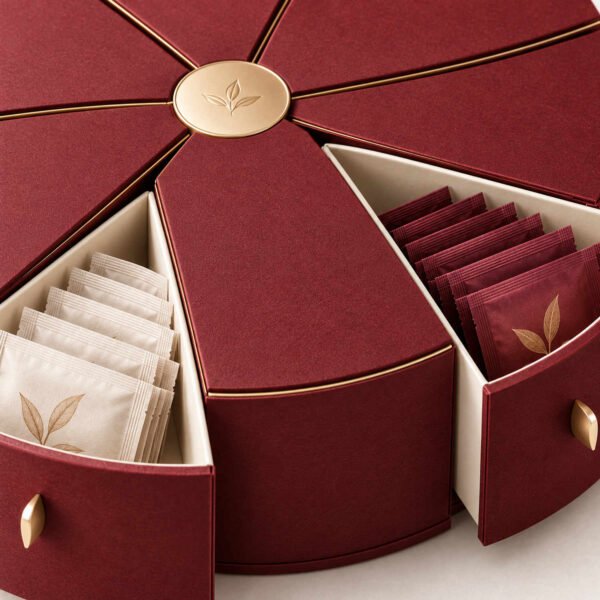
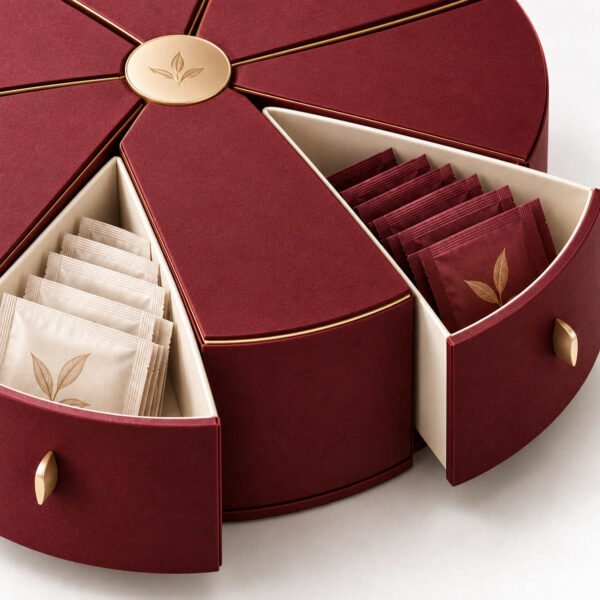
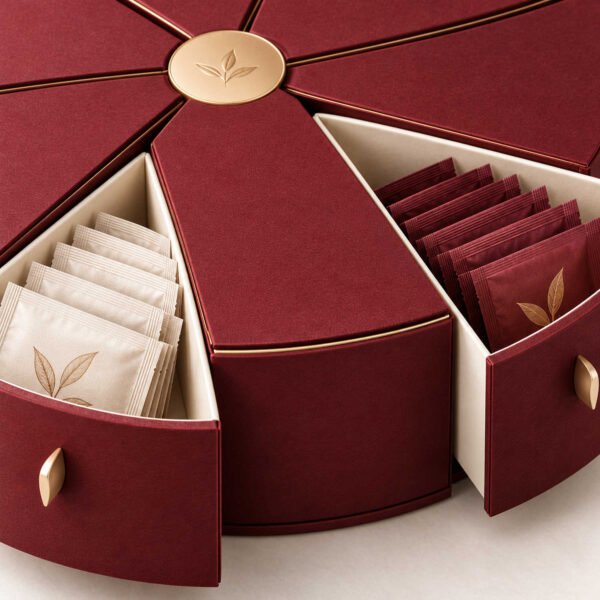
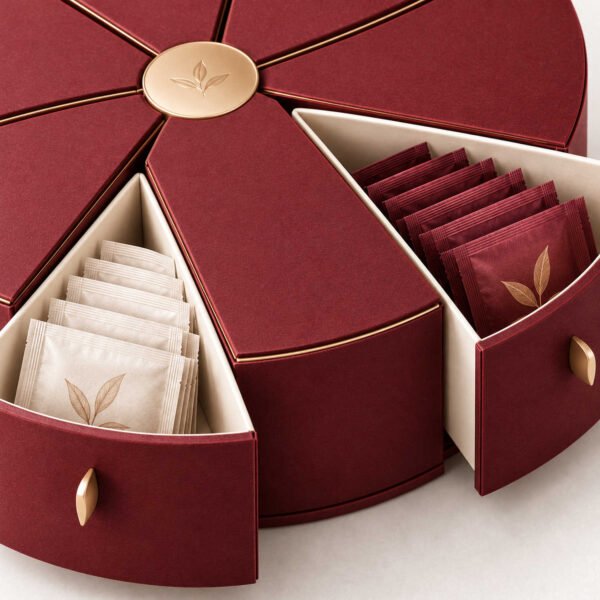
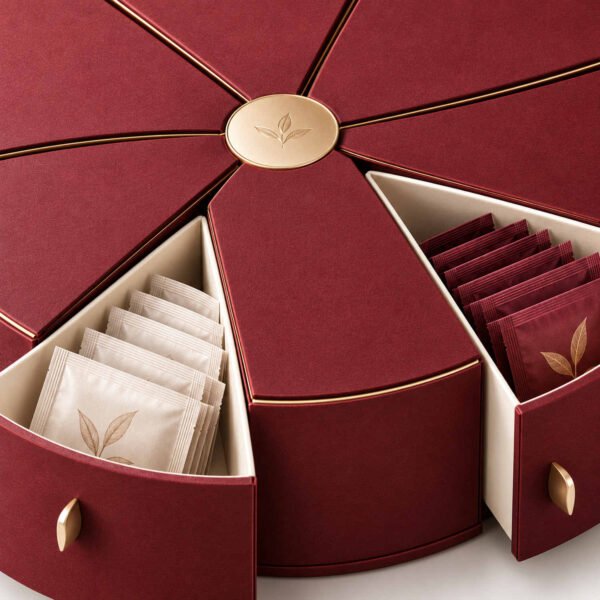
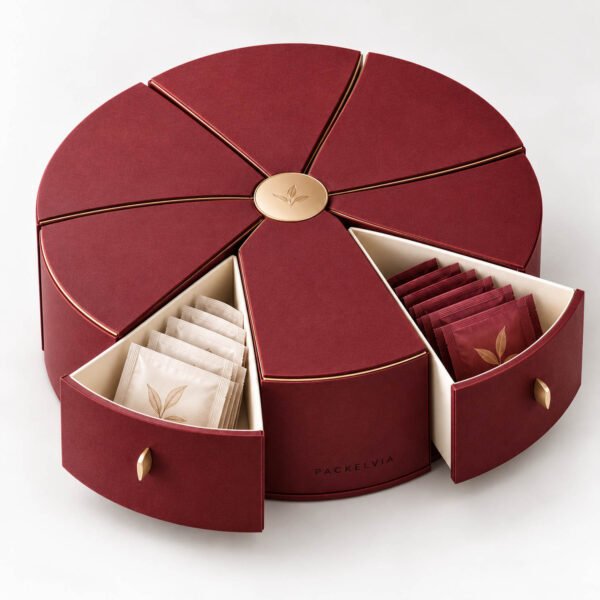
This radial drawer tea gift box is built as a round case divided into wedge-shaped drawers. Its shallow drum proportions combine a flat top marked by radial seams, a curved outer outline and drawers that open outwards.
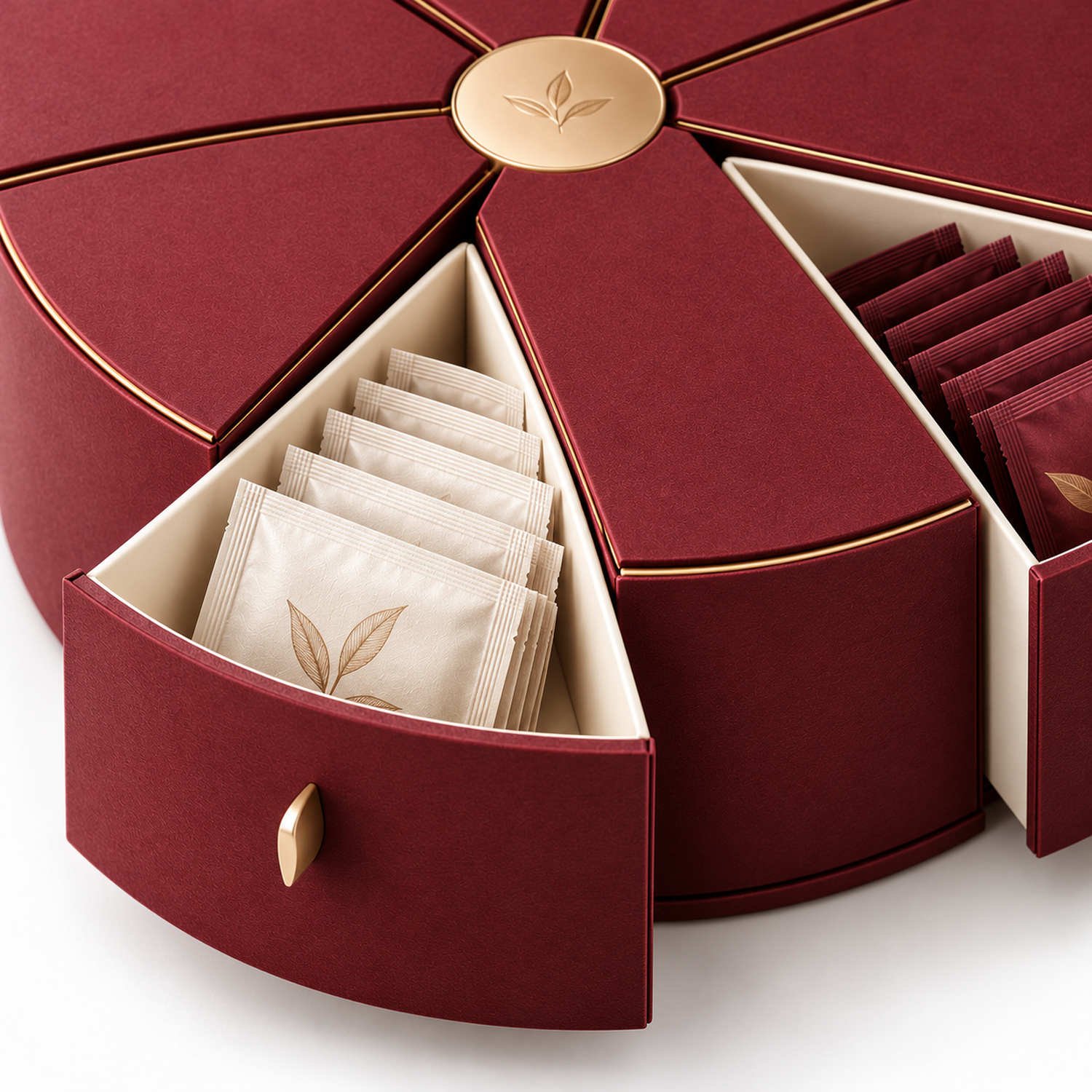
Each wedge drawer has a cream interior and a small gold-tone pull detail on its curved outer face. A gold-tone disc marks the centre where the top divisions converge; its attachment and the structure beneath it are confirmed on the sample.
It is built for tea sachet assortments and boutique gifts. The format presents the selection as one circle that can be opened a wedge at a time. Sachets shown inside are illustrative; the case and its drawers are the product.
What you receive
One assembled case with the wedge drawers fitted, cream interiors installed, gold-tone pull details attached and the centre disc in place.
Nothing needs assembling. Sachets are not included, and this box is not a barrier pack — tea remains in suitable sealed primary packaging, which the case holds as supplied.
All drawers are packed closed and secured, with protective support around the curved case as agreed in the packing plan. Bands and shaped fitments are confirmed for the final dimensions and shipping arrangement.
Construction and materials
Four main elements: the circular case, wedge drawers, cream interiors and centre disc.
The case has a round outline and a top divided by radial seams. Each drawer follows a wedge profile with straight side edges and a curved outer front carrying a pull detail. The cream interior follows the drawer shape.
Board, paper, lining attachment, curved-wall forming and centre construction are confirmed on the approved sample. The images do not establish the hidden base structure, exact tip truncation, disc attachment or tested performance.

The radial layout
The visible divisions converge towards one centre, so their alignment is checked as a complete set. Drawer angles, seam widths and the centre detail all affect whether the closed top reads as an evenly divided circle.
The effect of an angular error depends on the radius and on how the drawer is located. It cannot be described as one fixed millimetre offset along the entire seam. Review the actual drawing and sample for interference, uneven gaps and off-centre divisions.
A central clearance area or shortened drawer tips may be used where the construction requires it, but the image alone does not show whether that method is present or how large the clearance is.
Wedge count, angles, hub clearance and the centre-disc arrangement are agreed together before production.
The wedge drawers
Each drawer must fit the circular outline while opening smoothly along its intended direction. Curved fronts are checked together so no drawer stands proud or sits noticeably inside the surrounding perimeter.
Side clearances are reviewed from the outer rim towards the hub. Uneven clearance can cause visible wedge-shaped gaps or make a drawer rub or twist as it opens.
The reference does not establish hidden guides, rails, stops or catches. The guiding method, permitted travel and any retaining feature are specified for the project and checked with filled drawers.
Outer profile, seam clearance, opening effort and whether a stop is fitted are confirmed on the sample.
Capacity and interior
A wedge becomes narrower towards the centre, so usable capacity depends on the complete drawer shape and the dimensions of the filled sachets, not on one width alone.
Sachets can be presented on edge in a fan-like arrangement or laid in a stack where the drawer dimensions allow. Neither orientation automatically holds more: capacity depends on sachet width, height, thickness and the available clearance.
Check that the filled packs remain below the closing surfaces and can be removed without catching a seam or pull fixing. Choose the intended arrangement before the drawer is sized.
Send filled sachet dimensions, the quantity per selection and your preferred loading direction. Interior depth, lining and retention are developed around that arrangement.
Colours and finishes
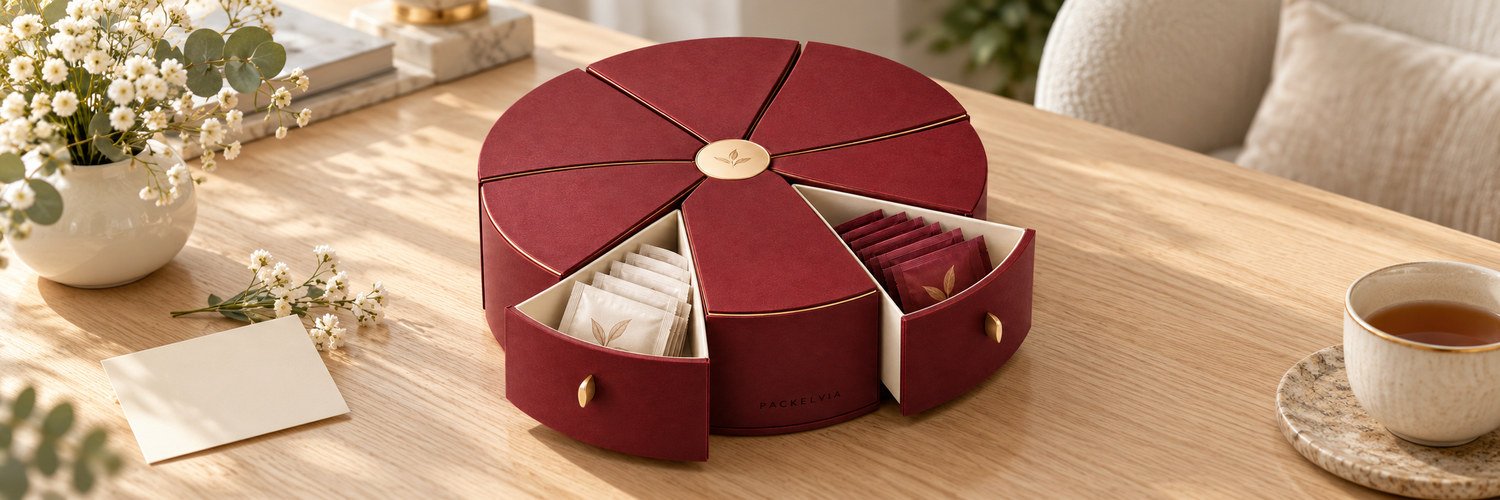
Reference colours are burgundy for the case, drawer fronts and top panels, cream for the interiors, with gold-tone pull details and a centre disc. Case, interiors and trim are specified separately, so the design can follow the reference contrast or reverse the burgundy and cream placement.
Finishes include plain wrap, printed artwork and foil lines. Review the curved outer surfaces, top edges and seam alignment on the sample. Forming and wrapping methods are selected for the actual geometry and materials rather than assumed from the image.
Personalisation
Printing can be placed on the top sectors, curved outer faces and drawer fronts. Artwork can sit within a sector or repeat around the circle. A design crossing seams is interrupted when a drawer opens, so check both open and closed views.
The centre disc is a natural focal point for a compact mark. Its available area, material and compatible branding method are confirmed with the final specification.
Artwork is checked against the dieline and assembled sample so sector positions, seams and pull details remain aligned.
Preparing Illustrator artwork? See Adobe’s guide to packaging artwork files before sending linked assets and fonts.
Care and reuse
The box is paper-based: keep it dry and wipe with a dry or barely damp cloth. Pull each drawer along its intended radial direction without forcing it sideways. Support the case from the base when moving it, and secure the drawers as agreed for transport.
Store it closed. After the tea sachets are removed, it can be reused as a circular organiser for small, light objects that fit the wedge compartments. Keep tea in suitable sealed primary packaging.

Dimensions and specifications
| Reference | PK-TC-01 |
|---|---|
| Type | Tea gift box, circular case with radial wedge drawers |
| Structure | Circular burgundy case, cream-lined wedge drawers, gold-tone pull details and centre disc |
| Wedge count | Set with the radial layout; exact count and angles confirmed on the drawing and sample |
| Drawer tips | Tip shape, hub clearance and relation to the centre disc confirmed on sample |
| Outer profile | Curved fronts checked together for a consistent circular outline |
| Drawer travel | Radial opening; guides, rails, travel and retaining features confirmed on sample |
| Capacity | Developed from the full drawer shape, filled sachet dimensions and count |
| Dimensions | Made to your sachets — diameter, height and wedge angles to be confirmed |
| Board and paper | Confirmed on the sample |
| Colour options | Case, interiors and trim specified separately |
| Finishing | Plain wrap, printed artwork, foil lines |
| Minimum order | 500 boxes for custom production; smaller quantities to be confirmed |
| Packing | All drawers closed and secured; curved-wall protection as agreed in the packing plan |
| Contents | Case and drawers only; sachets are illustrative and supplied separately |
Delivery and lead time
Start with a sample. Check the radial seam alignment around the centre disc, the circular outline formed by the drawer fronts and the opening effort of each filled drawer. Review retention and any interference between adjacent drawers as part of the same check.
Send the filled sachet width, height and thickness, count per selection, quantity of boxes and required arrival date. The sample is made to that specification; production follows approval, with artwork and packing method signed off at the same time. Lead time depends on the dies, curved-wall forming and drawer fitting, and is confirmed per order once the specification and date are known.
Frequently asked questions
Are the sachets included?
No. The case and its drawers are the product; sachets in the images are illustrative and supplied separately.
How many wedges does it have?
The wedge count is set with your selected layout and confirmed on the structural drawing and sample. It changes the wedge angles, drawer widths and available capacity; the illustrative image is not a fixed production specification.
Do the drawer tips meet at the centre?
The centre disc is visible, but the hidden tip construction is not established by the image. Tip shape and hub clearance are developed with the drawer fit and confirmed on the sample.
Does it hold more sachets stood up or laid flat?
It depends on the filled sachet dimensions and the drawer shape. Both arrangements can be reviewed with real packs; choose the presentation and required count before fixing the drawer dimensions.
Can the drawers be locked?
The image does not establish a lock or hidden retaining mechanism. Review any lock, stop or catch requirement before sampling. A travel stop that prevents full removal is not the same as a lock that holds a drawer shut.
Is it suitable for food?
The box is packaging, not a food-contact article. Tea sachets stay in suitable sealed primary packaging; any direct-contact or barrier requirement is specified separately and confirmed on the sample.
Compare the nine compartment tea sampler box for a square selection layout, or explore our tea and coffee packaging collection.
Review materials, printing and finishes, or send your sachet dimensions and sample requirements.
Images are AI-generated packaging design visualizations, not photographs of a verified production sample. Final materials, construction, drawer function and fit require specification review and sample approval.