














Product description
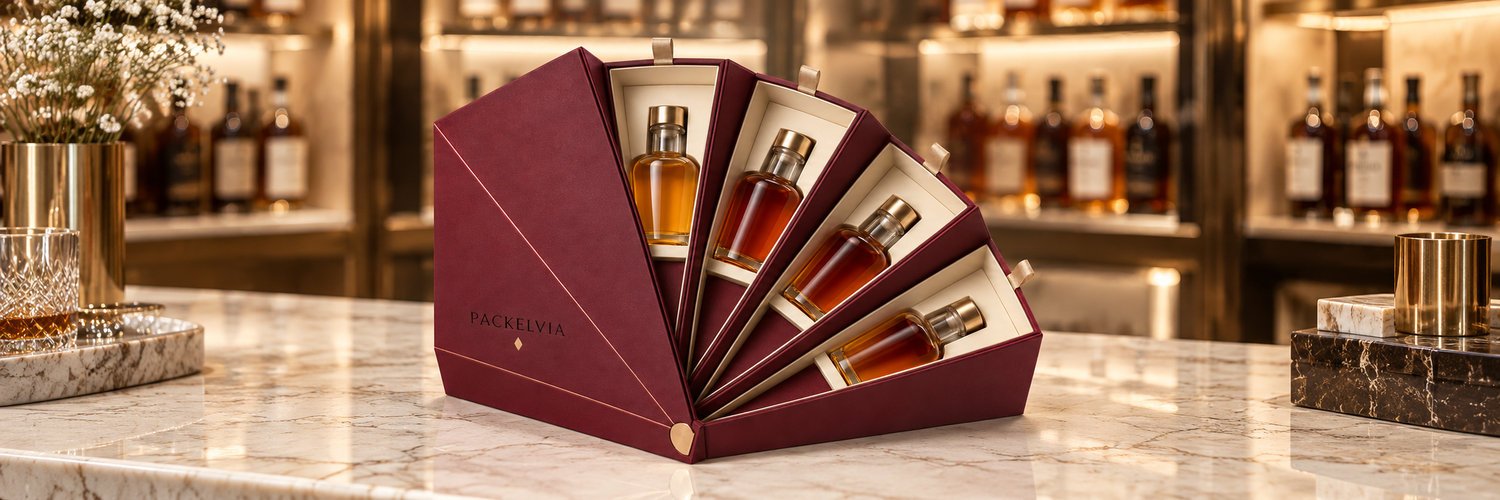
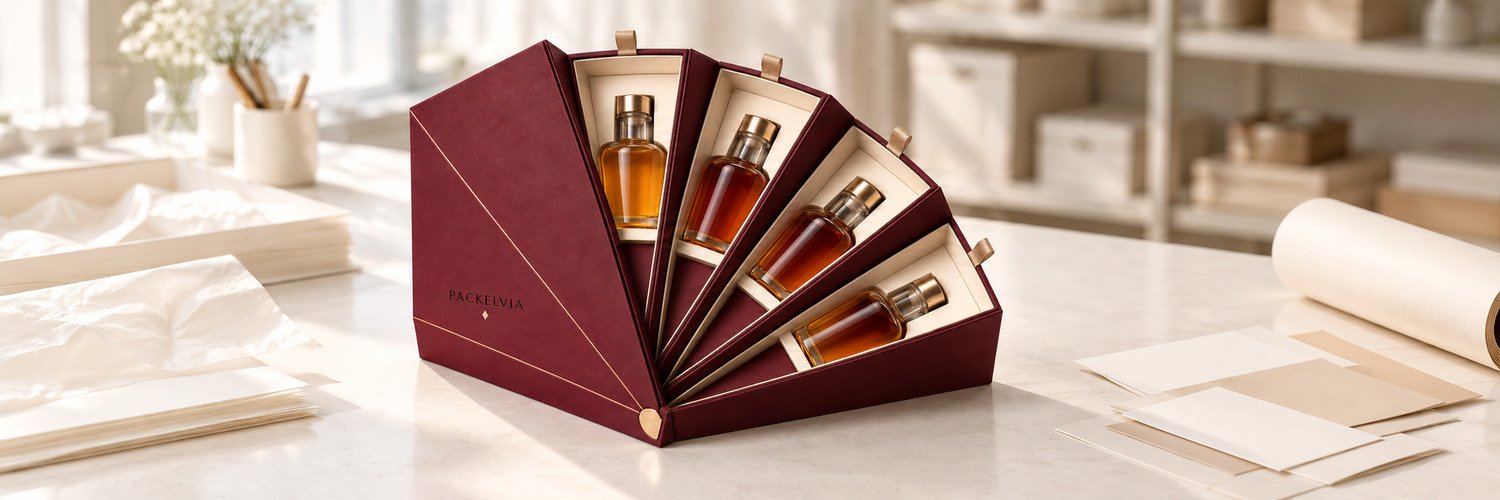
This fan shaped spirits tasting box presents four miniature bottles in separate cream-lined trays. Opened, the burgundy case spreads into a fan, showing the bottles in sequence rather than in a straight row.
A broad burgundy cover sits beside the trays, with a fine gold-tone border near its edge. The folding arrangement brings the trays together for closing; the exact movement and closed profile are confirmed on the sample.
The bottles shown are illustrative and are not included. The product is the fan body, fitted trays and cover.
What you receive
One assembled fan body with four fitted bottle positions and an attached cover. The joints and closing components are fitted before delivery, so there is nothing to glue or assemble at packing.
No bottles, bag, card or ribbon are included unless listed with the order.
This is presentation packaging. Bottle retention, cushioning and an outer carton for shipping are specified separately; the images do not establish tested transport performance.
Construction and materials
The design consists of four bottle trays, their connecting structure and the outer cover. Each tray has a cream-lined interior and a recess developed for one miniature bottle.
The connections allow the trays to open as a fan and return to the closed arrangement. Joint material, pivot construction and reinforcement are selected for the intended use and checked on the sample.
Board, paper and lining materials are confirmed before production. A cloth spine, paper joint or particular hinge construction cannot be specified from the image alone.
The fan and its one point
The tray edges converge visually toward a common inner end. Consistent alignment gives the opened case its fan shape and helps the trays come together when closed.
Check both positions on the sample: the trays should open without interference and close with an even outer edge. Joint spacing, tray thickness and the filled bottle dimensions all affect the result.
Any dimensional tolerance is agreed on the structural drawing. The effect of a small error depends on its location and direction; a fixed multiplication ratio is not assumed.
The hub, cut back
The inner end needs room for tray walls and the connecting components. It is developed with clearance between adjacent parts so the trays can move without rubbing or crushing their corners.
The shape and size of any hub, disc or pivot are confirmed during sampling. A visible round detail does not by itself establish how the joint works beneath the lining.
Bottle body width, seat position and wall thickness are reviewed together at this end. Send all four bottle profiles if the set contains different shapes.
How the fan closes
The closed size is determined with all four bottles seated. Tray floors, walls, joints, recess depth and cover overlap all contribute to the finished stack.
The cover must reach its closing position without compressing a bottle or forcing the trays together. Closure type and location are confirmed on the sample, including any fitting suggested by the reference.
Support the filled sample from underneath while checking cover alignment and retention. Do not lift a loaded case by one corner or by its cover.
Inside each tray
Each tray has one fitted recess, with room for the bottle body, shoulder and cap. Cream floors and inner wall faces contrast with the burgundy exterior when the fan is open.
Seat depth is developed around the bottle profile and removal method. The bottle needs enough support to stay positioned, with a practical grip area for lifting it out.
The reference shows the caps toward the outer edge. Final orientation and clearance are checked for each bottle, including labels and any projecting closure details.
The bottles and their seats
A bottle lying in a tray may roll or move lengthwise unless its support is shaped appropriately. The seat is therefore developed around the actual body and shoulder, with any additional retention specified separately.
A shoulder stop can limit movement along the tray; controlling rotation may require support that matches the bottle’s cross-section or another suitable retaining feature. Neither is a universal guarantee on its own.
Use filled, labelled and capped bottles to check movement, removal and contact with the tray walls. Look for pressure on labels, caps and lining as the fan closes.
Colours and finishes
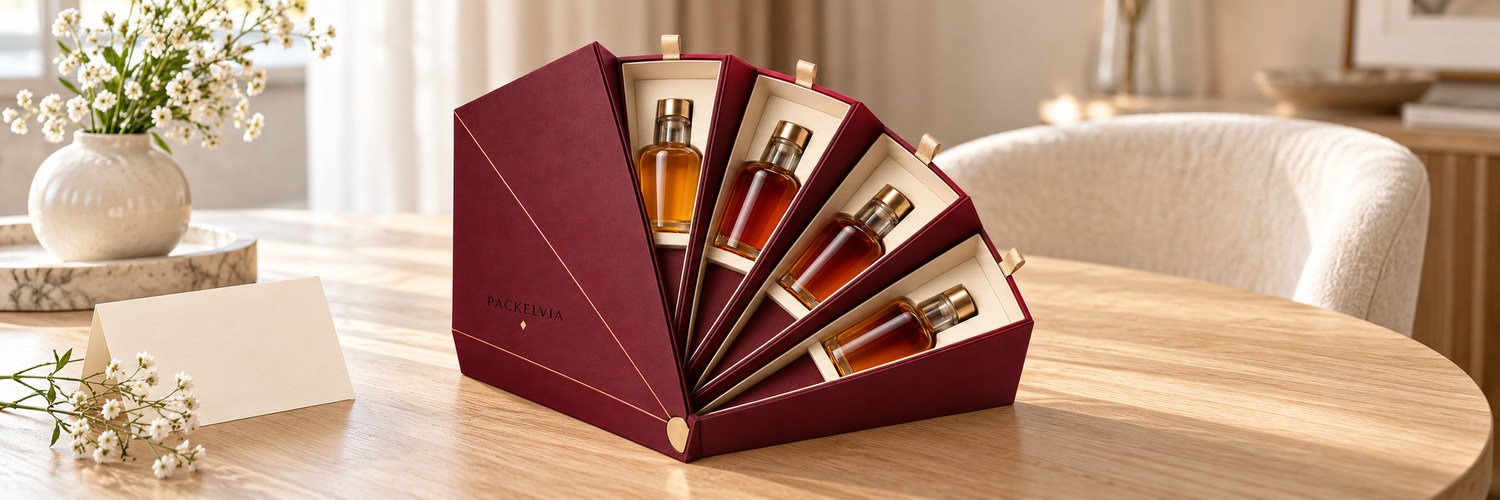
Reference colours are burgundy on the cover and tray exteriors, cream on the tray floors and inner walls, with fine gold-tone accents. Exterior, lining and decorative colours can be specified separately.
Plain wrap, printed artwork and foil details can be reviewed for the selected paper. A border set within the cover edge can follow the fan outline.
Check the finish in the open and closed positions, including visible inner edges and the areas around the joints.
Personalisation
The outer cover provides the largest branding area. A brand name or small artwork can be placed there, with the layout checked in the agreed closed view.
The four trays can carry individual numbers or tasting names so each bottle has a clear place in the sequence. Keep text clear of the bottle seats and moving joints.
Artwork is reviewed against the dieline and assembled sample before production.
For artwork handover, see Adobe’s guide to packaging Illustrator files.
Care, reuse and transport
Keep the paper-based case dry and clean it with a dry or barely damp cloth. Support the base and guide the trays gently through their agreed opening range.
Tell us whether the box is intended for occasional gifting or repeated shop display. Joint durability needs to be assessed for that use; no opening-cycle life is claimed from the images.
Store the case closed without loading the cover. For shipping, bottle retention, cushioning and an outer carton are developed separately from the presentation structure.
Dimensions and specifications
| Reference | PK-WS-07 |
|---|---|
| Type | Fan shaped spirits tasting box, four bottle trays |
| Structure | Four cream-lined bottle trays with connecting structure and burgundy cover |
| Joints | Material, movement range and durability requirements confirmed on sample |
| Pivot and hub | Construction, clearances and any covering disc confirmed during development |
| Trays | One fitted recess per miniature bottle |
| Bottle orientation | Caps toward the outer edge in the reference; confirmed for your set |
| Seat | Support and retention developed for bottle profile, label and cap |
| Closed stack | Checked with all four bottles fitted |
| Closure | Type, location and retention confirmed on sample |
| Open angle | Confirmed on sample, with the display footprint measured |
| Dimensions | Made to your set — bottle diameters, full lengths, filled weights and box dimensions to be confirmed |
| Board and paper | Confirmed on the sample |
| Colours | Exterior, tray lining and decorative details specified separately |
| Finishing | Plain wrap, printed artwork and foil details; edge treatment as agreed |
| Transport | Presentation packaging; shipping protection specified separately |
| Minimum order | 500 boxes for custom production; smaller quantities to be confirmed |
| Contents | Fan body, fitted trays and cover only; bottles are illustrative and not included |
Delivery and lead time
Start with a sample and provide all four filled, labelled bottles with their caps fitted, or complete dimensions and weights for the set. Different bottle profiles may require different recesses.
With the bottles in place, check the closed outer edge, closure engagement, cap and label clearance, bottle movement and the space needed for the open display. Agree the artwork and packing method before production.
Send the set details, quantity, destination and required arrival date. Lead time depends on tooling, joints, connecting components and finishing, and is confirmed per order.
FAQ
Are the bottles included?
No. The product is the fan body, fitted trays and cover. The bottles shown are illustrative and supplied separately.
Why might the four recesses be different?
Each recess is sized to its bottle. Different miniature bottle shapes may need different seats; identical bottles can use the same seat design in all four positions.
Does the fan open flat?
The reference shows an open fan arrangement. The final opening angle and display footprint are measured on the sample; a flat or half-circle opening is not assumed.
Will the bottles turn in their seats?
Support and any retention are developed around your filled bottles. Rotation and lengthwise movement are checked on the sample, together with comfortable removal.
What holds it closed?
The closure type and its position are confirmed with the sample. Check that it engages correctly with all four bottles fitted and without compressing the contents.
Does the packaging touch the spirits?
The spirits stay in their own sealed bottles. Any component intended to contact the liquid directly would require a separate specification and supporting documentation.
Compare the stepped shoulder spirits box for a single bottle, explore more wine and spirits boxes, or review packaging customization options.
Send Packelvia your four-bottle set dimensions.
Images are AI-generated packaging design visualizations. Final construction, movement and fit require approval of a physical sample.