






Product description
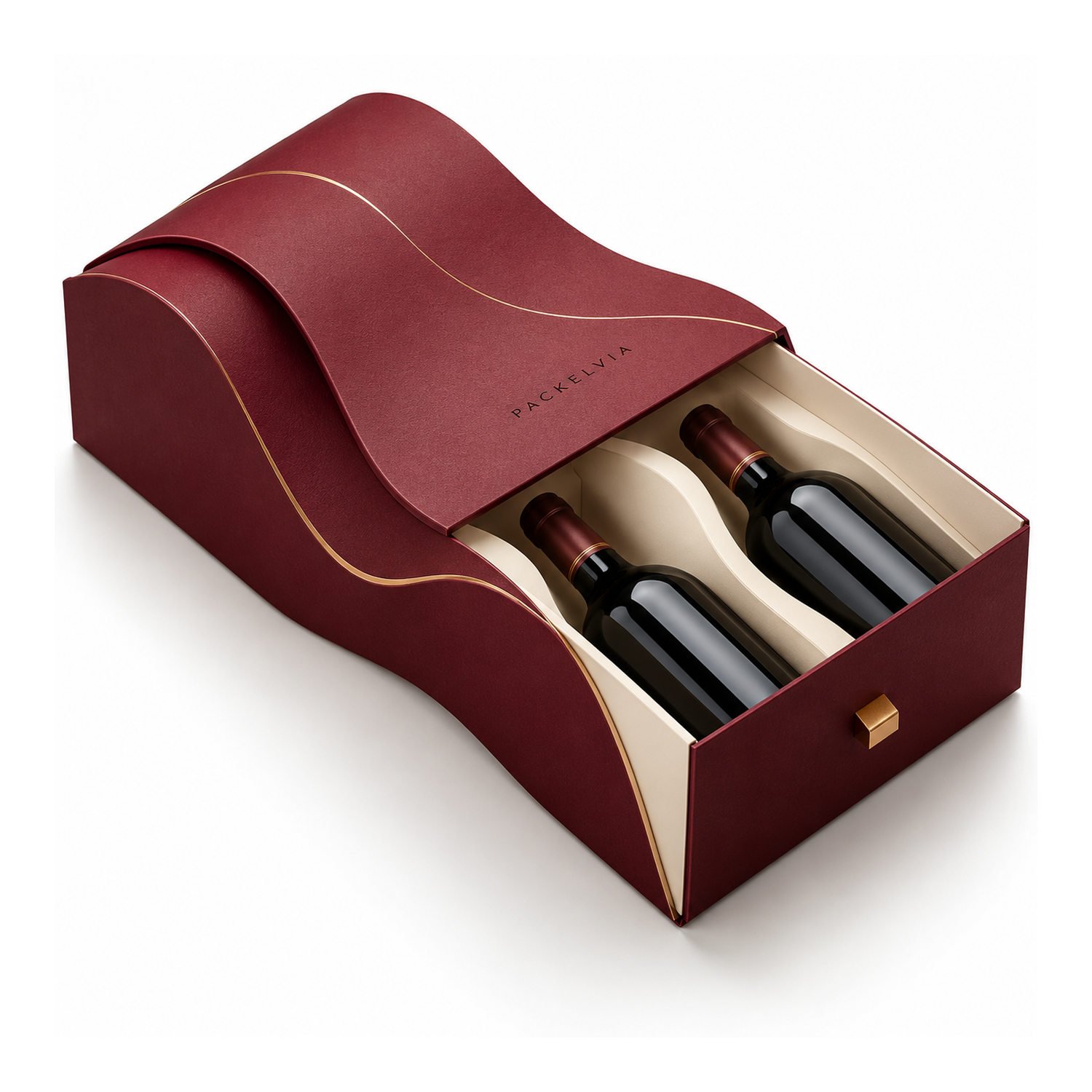
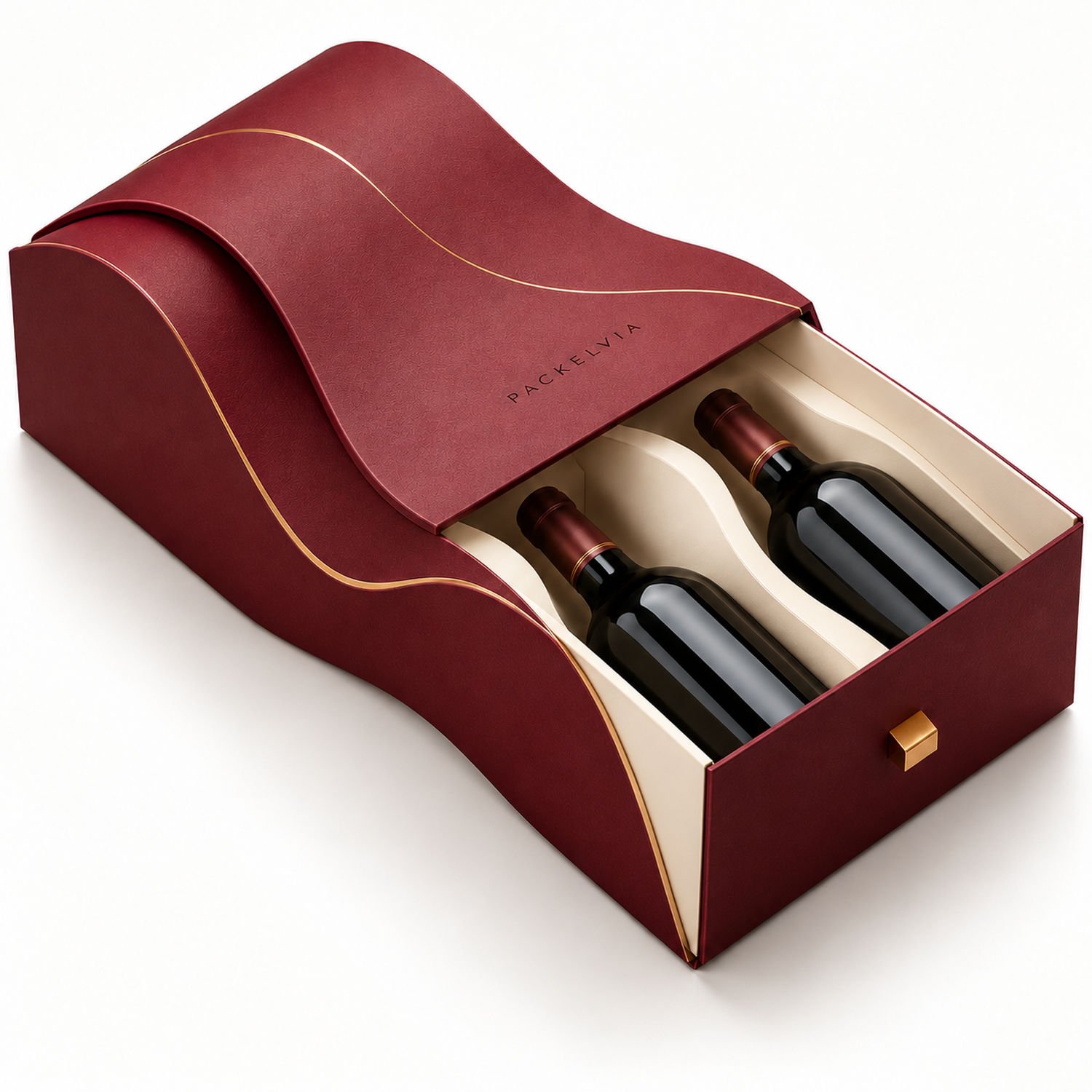
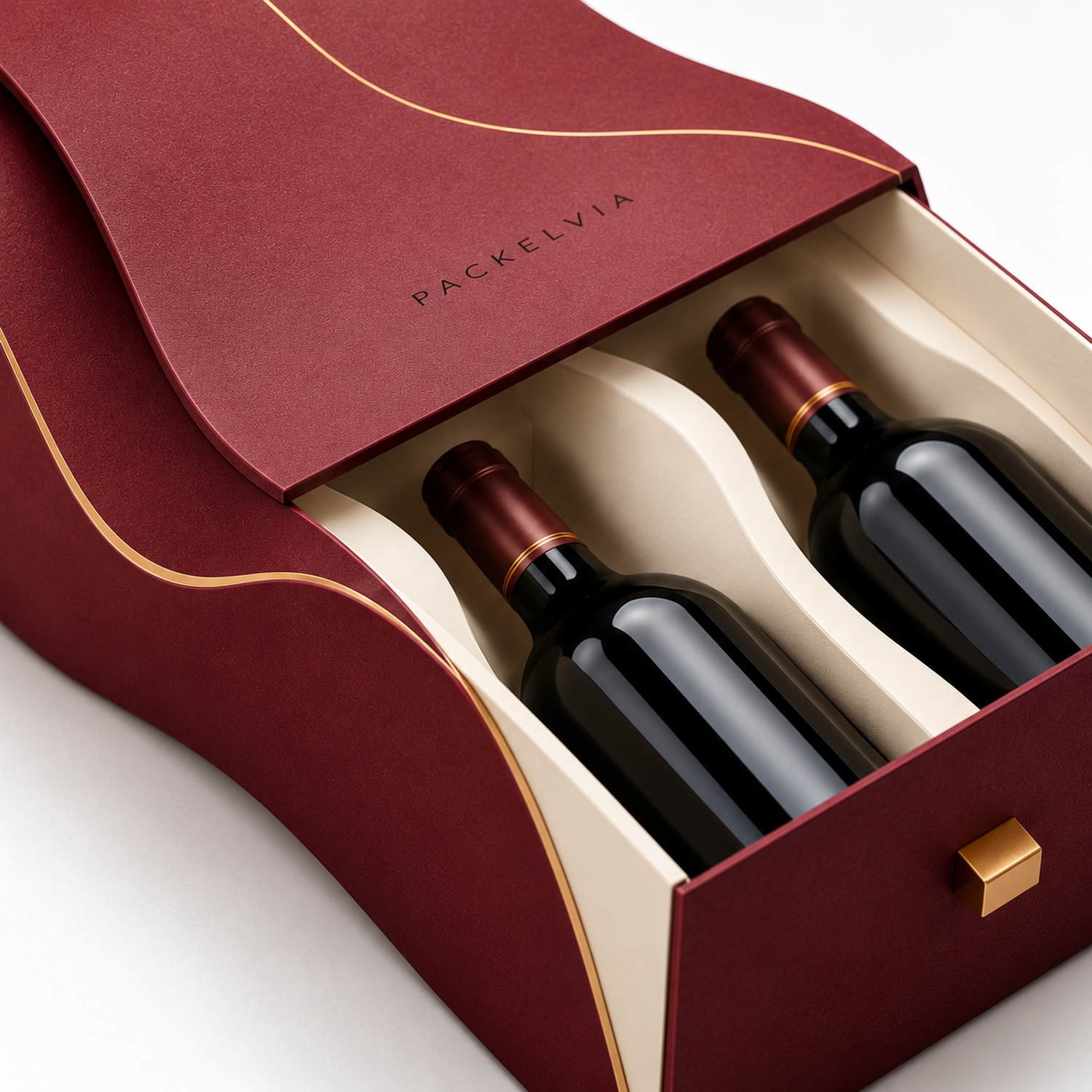
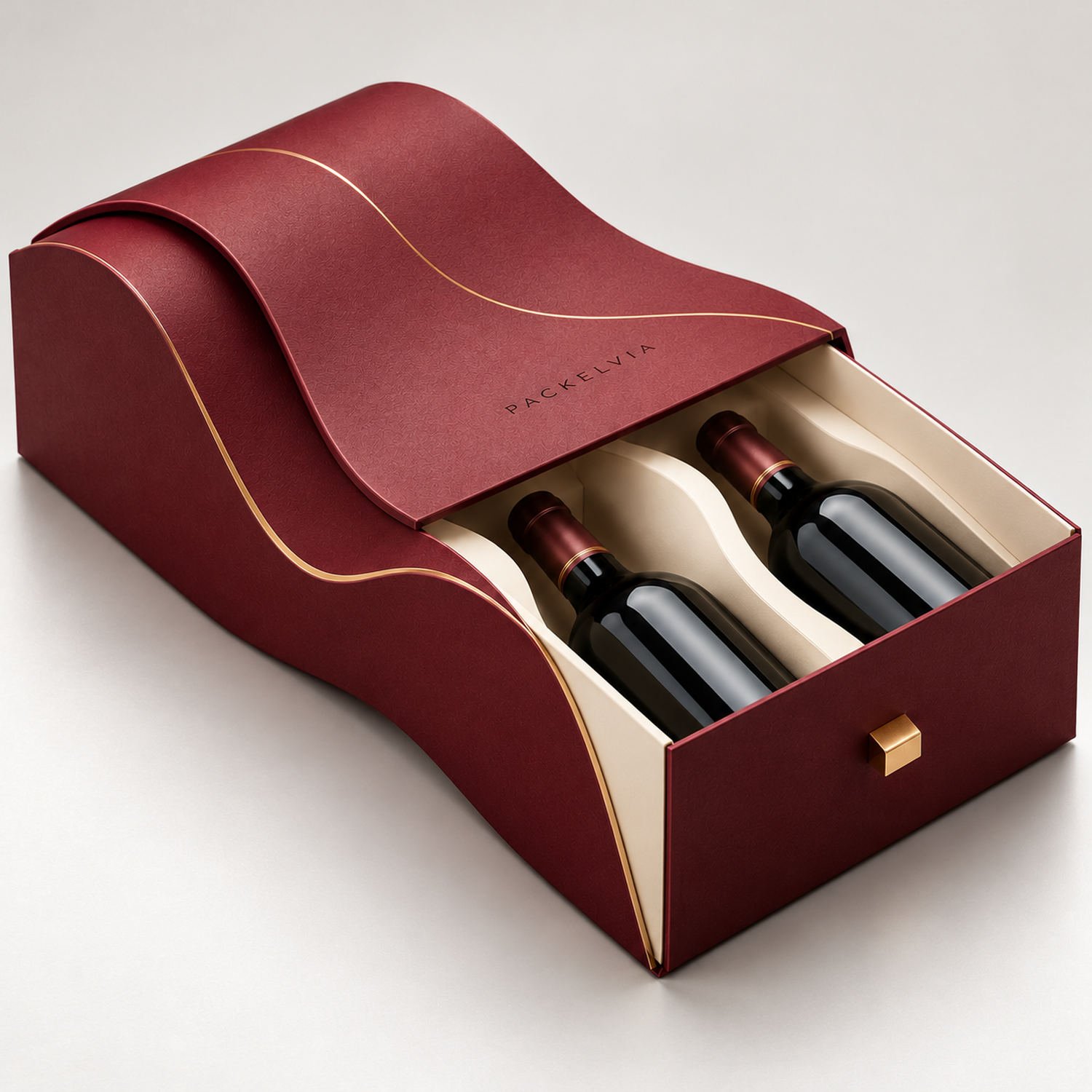
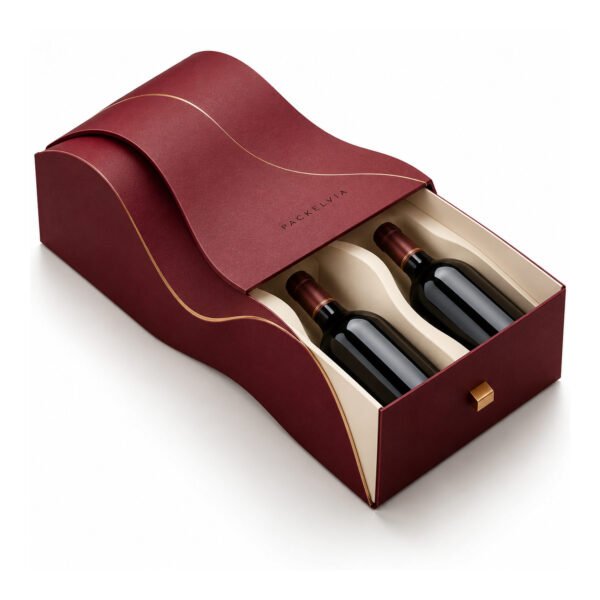
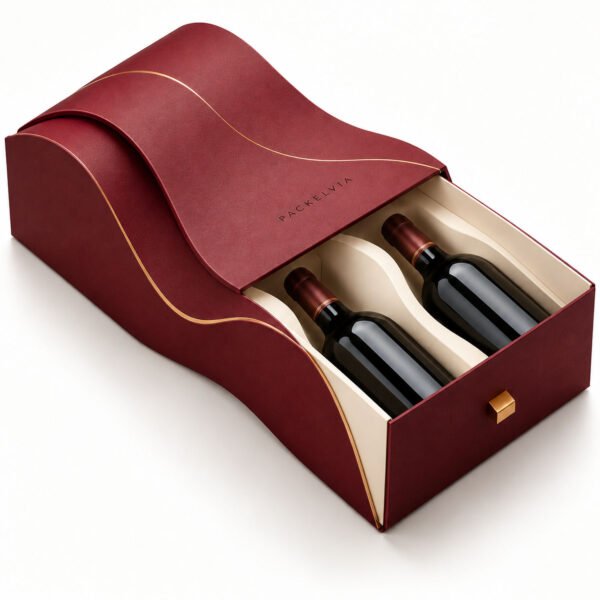
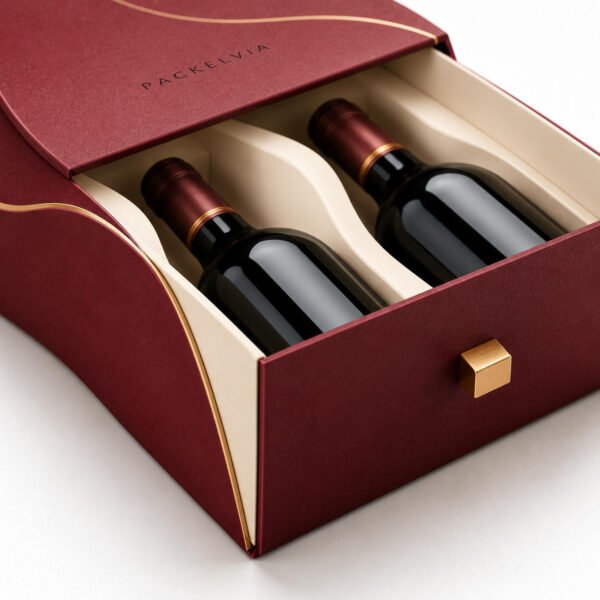
This is a wine box built as a sleeve and a drawer. The sleeve is burgundy and its outline is a wave: it rises to a crest over the middle of the box and falls away at each end. One drawer runs inside it and pulls out from the front.
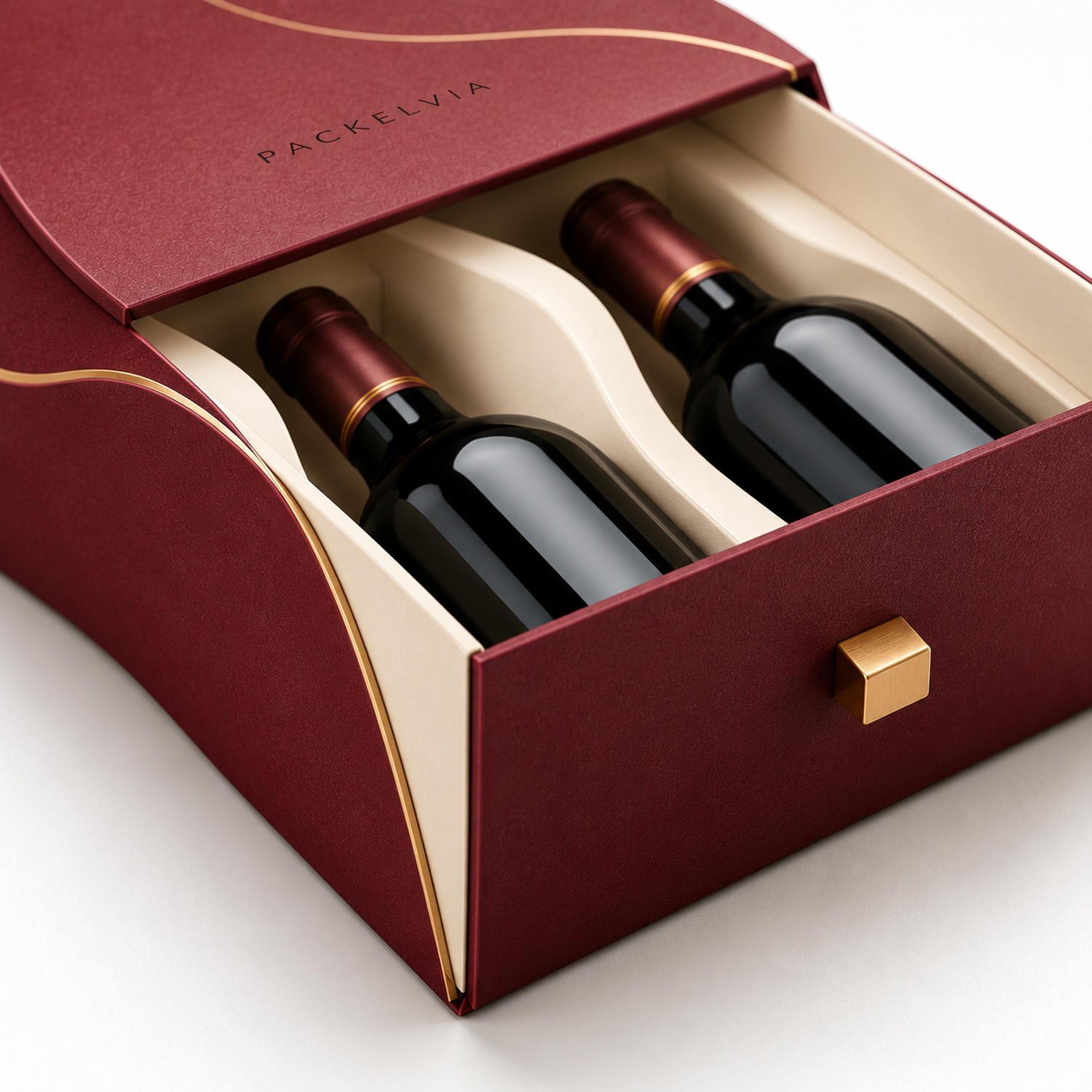
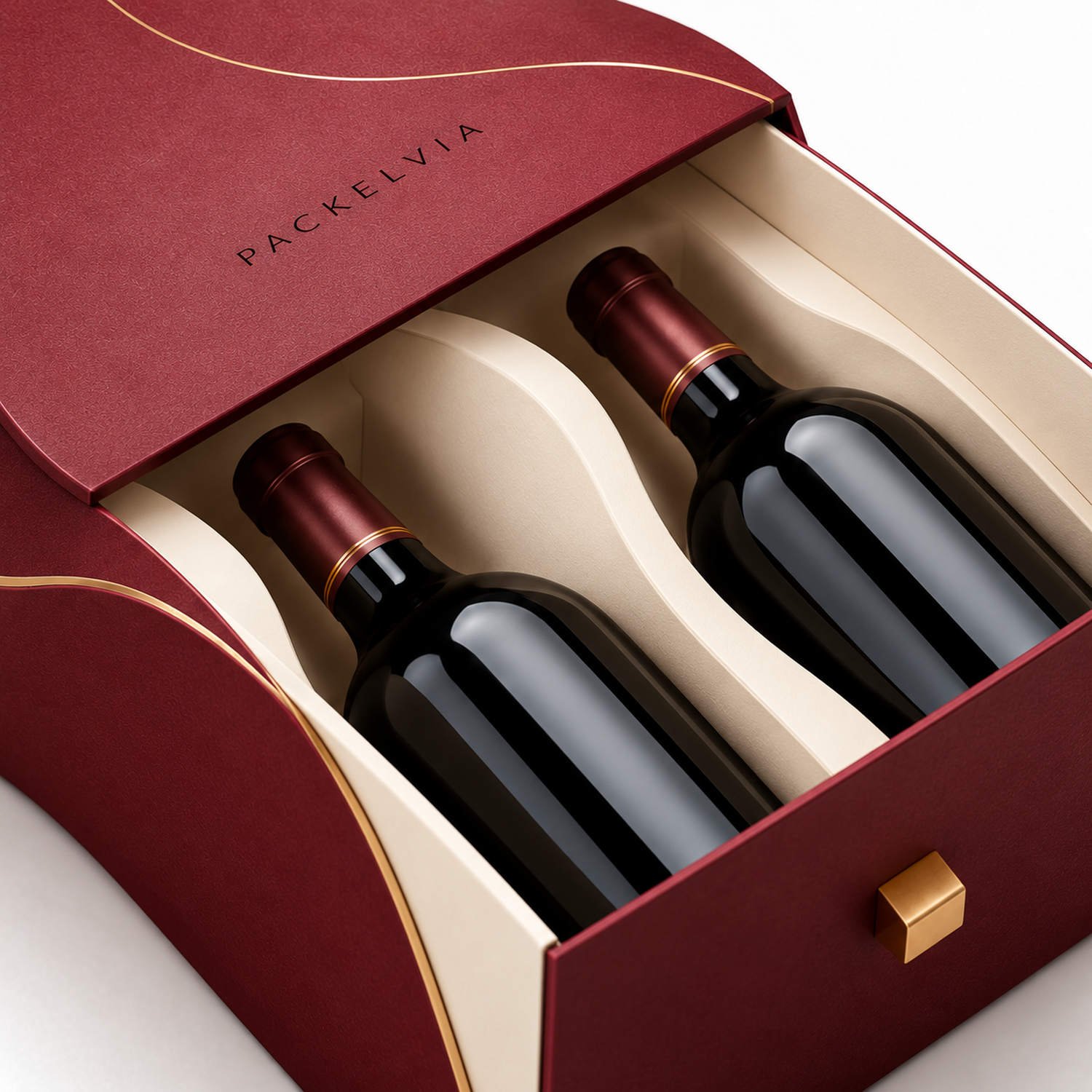
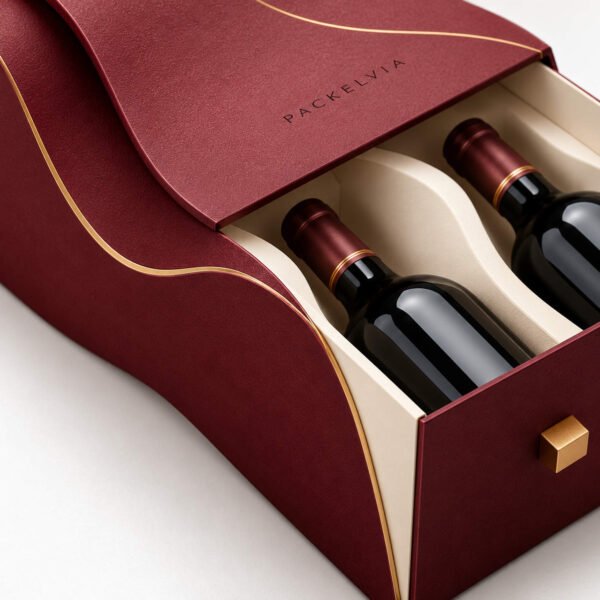
Inside the drawer is a cream tray with two channels side by side. Two bottles lie in them on their sides, necks toward the drawer front, so both are seen at once the moment the drawer starts to move — the sleeve’s wave uncovers them progressively rather than all at once.
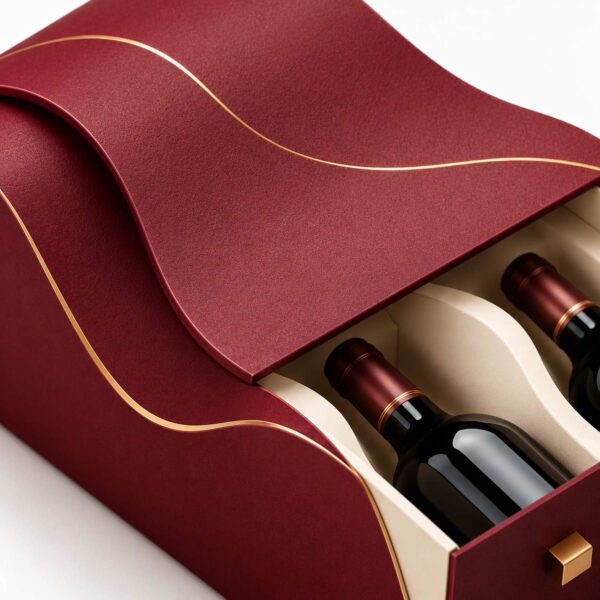
A fine pale line follows the wave along the sleeve’s edge, and a small metal pull sits at the centre of the drawer front. Burgundy outside, cream inside. The bottles in the photograph are illustrative; the sleeve, the drawer and the tray are the product.
What you receive
One wave-profile sleeve, closed at the back and open at the front, and one drawer already fitted with its cream two-channel tray.
Nothing needs assembling. The bottles are not included, and neither is anything else — no bag, no card, no ribbon — unless it is listed with the order.
This is presentation packaging. The drawer has no stop and no latch; it is held by friction and by being pushed home, and no transport performance is claimed. If the box travels, the retention of both the drawer and the bottles is a separate specification.
Construction and materials
Three parts: the sleeve, the drawer, and the tray inside it.
The sleeve is a shell that was cut to a wave and then closed into a tube, with a back panel sealing one end. The drawer is a rigid box with its own front face and floor. The tray is a fitted insert with two channels cut into it, one per bottle.
Board, paper, the pull and the way the sleeve’s crest is formed are confirmed on the approved sample; the photographs do not establish material specifications, and a single view cannot settle how the crest surface is made.
The wave, and how it is made
The wave is not a print on a box; it is the box’s outline. That is what makes it the hard part.
Cutting the edge is straightforward — a curve is only a cut. What is not straightforward is the surface between the two edges. In the photograph the crest rolls over both along the length and across the width, and a surface that curves in two directions cannot be pressed out of a flat sheet of paper-faced board. Paper-faced board bends readily one way and barely at all the other, because the facing has to either stretch or wrinkle.
So the crest is one of three things, and they look different at the edge: a shell laminated over a form, which gives a smooth roll and a clean edge but needs a mould; a surface built from a series of narrow facets, which is flat stock and cheap but shows a line at every facet under glancing light; or a kerfed bend, where the board is slit on the inside and pulled into a curve, which works at a generous radius and fails at a tight one. Which one this sleeve uses is confirmed on the sample, and the test is a hand run along the crest with the light behind it.
A straight drawer in a curved mouth
A drawer is rectangular. The sleeve’s mouth is a curve. Those two facts do not sit quietly together, and the whole character of the box comes out of the argument between them.
The first consequence is that the drawer front cannot be a plain rectangle. If its top edge is straight, it cannot meet a wave-shaped mouth: it will touch at the crest and stand open at the troughs, or the reverse. So the front’s top edge is cut to the same wave, and that is what allows the drawer to be pushed home with no gap — and it is also why the front is a special part rather than a lid.
The second consequence is the reveal. As the drawer travels, the tray’s straight top edge passes under a mouth whose height is changing. At the crest the sleeve covers most of the bottle; at the trough it covers least. The bottles therefore appear from under the crest in a way that no straight sleeve can imitate — and equally, no adjustment can make the gap at the mouth constant, because the gap is a property of the geometry, not of the fit.
Sleeve clearance
Two clearances matter, and they are not the same clearance.
The first is the sliding fit on the bottom and the two sides, which is ordinary. The second is the fit under the crest: because the sleeve’s top is a curved surface, its inner face is lowest somewhere along the wave, and that point — not the average — is what the drawer has to pass. A drawer that fits everywhere except under the lowest part of the crest will bind halfway out and feel, to a buyer, like a broken drawer.
There is a third effect worth knowing about. A sleeve closed at the back and open at the front is a piston: as the drawer is pulled, air has to get in behind it. A tight lining plus a tight slide makes the drawer feel damped, and on a fast pull the lining can be drawn forward with the tray. A small vent, or a deliberately loose fit at the back, is what cures it — and it is usually discovered late, so it is worth deciding early.
The two channels
The tray’s width is set by two bottle diameters plus the ridge between them plus the two outer walls, and the ridge is the dimension that gets squeezed.
That matters because the ridge is what keeps the bottles apart. Two bottles lying side by side, in a box that is handled, will move toward each other; if the ridge is thin, they meet, and the meeting point is on the label, where a rub shows. The ridge also carries the load of the tray’s own middle, which is the span between the two heaviest things in the box.
The channels themselves are the usual compromise: deep enough to stop the bottles rolling, shallow enough that a hand gets under a bottle to lift it. And because two bottles are always compared side by side, the two channels have to be the same depth and the same distance from the walls — a difference of a millimetre between them is much more visible than the same difference anywhere else on the box.
The pull, and why it is centred
The pull sits in the middle of the drawer front, and that position is functional rather than decorative.
A wide drawer pulled from one corner does not slide: it rotates slightly in the sleeve, one side leading the other, and the leading corner digs into the wall while the trailing side opens a gap. Two bottles make that worse, because the drawer’s mass is spread out along its width. A centred pull keeps the two sides travelling together.
The pull also has a fixing to think about. Its shank or its back plate lands on the inside of the front face — which is exactly where the two bottle necks are, because the necks point forward. The fixing has to be flush or recessed; a screw tail or a rivet head protruding a millimetre into the tray’s front wall is a scratch on a neck.
Colours and finishes
Reference colours are burgundy on the sleeve and on the drawer’s outer faces, cream on the tray, the drawer’s inner walls and the sleeve’s lining, and a light metal for the pull.
The pale line along the wave is doing real work. A dark wave with no edge line reads as a shadow rather than as a shape — in a photograph it merges into the box behind it. One light line, following the cut, tells the eye that the wave is an edge and that there is a drawer underneath it. That is why the line in the photograph looks stitched rather than printed: it traces the cut, not a pattern.
Finishes include plain wrap, printed artwork, an edge line in a second colour and foil. On the crest, a foil line is difficult because the surface is curved; the flat side panels are where foil behaves.
Personalisation
The sleeve’s side panels are the printable flat areas, and their shape is the wave — so artwork has to be laid out inside the curve rather than inside a rectangle. A mark placed in the trough will be cut; a mark placed under the crest survives with the most room around it.
The crest itself is the largest uninterrupted surface on the box and the one that takes the light, which makes it tempting for a brand — but it is a curved surface, so anything printed on it is stretched as it crosses, and a straight rule printed across a double-curved roll comes out bowed. On the crest, a single solid shape is safer than a line of type.
Care, reuse and transport
Paper-based: keep it dry, wipe with a dry or barely damp cloth, and carry it from underneath — the crest is the part the hand naturally closes over, and it is the part that spans unsupported.
The two edges that take wear are the sleeve’s mouth, which the tray rubs every time the drawer moves, and the drawer front’s wave-cut top edge, which is thin because it had to be cut to a curve. Both should be checked on the sample after a few dozen open-and-close cycles, not on the first one.
For transport, the drawer has no stop and no latch, and the bottles are held only by their channels: bottle retention, drawer retention and an outer carton are a separate specification. A case that ships should have the drawer restrained independently.
Dimensions and specifications
| Reference | PK-WS-03 |
|---|---|
| Type | Two-bottle wine gift box, wave sleeve with drawer |
| Structure | Wave-profile sleeve closed at the back, one sliding drawer, cream two-channel tray |
| Sleeve crest | Surface curved along the length and across the width; laminated, faceted or kerfed — to be confirmed |
| Sleeve mouth | Cut on the wave; the drawer front’s top edge cut to the same curve |
| Clearance | Set under the lowest part of the crest, not averaged |
| Drawer | No stop, no latch; held by friction and by being pushed home |
| Venting | Closed sleeve acts as a piston; vent or looser rear fit to be confirmed |
| Tray | Two channels with a centre ridge; equal depth and equal spacing |
| Ridge | Thickness set so the two bottles cannot meet |
| Pull | Centred on the drawer front; fixing flush or recessed into the tray’s front wall |
| Dimensions | Made to your bottles — diameter, length, filled weight, spacing to be confirmed |
| Board and paper | Confirmed on the sample |
| Colours | Sleeve and drawer outsides burgundy, tray and linings cream, pull light metal |
| Finishing | Plain wrap, printed artwork, edge line in a second colour, foil on flat panels |
| Transport | Presentation packaging; drawer and bottle retention specified separately |
| Minimum order | 500 boxes for custom production; smaller quantities to be confirmed |
| Contents | Sleeve, drawer and tray only; bottles are illustrative and supplied separately |
Delivery and lead time
Send both bottles, filled, with the spacing you want between them — the spacing decides the ridge’s thickness, and the ridge is the dimension that gets squeezed.
Then check five things: whether the drawer pulls without binding anywhere under the crest; whether the front’s wave-cut top edge closes flush against the sleeve’s mouth at the crest and at both troughs; whether the drawer feels damped because the sleeve is acting as a piston; whether pressing the two bottles toward each other brings them into contact; and whether the pull’s fixing shows on the inside of the front wall where the necks sit.
Lead time depends on the wave die, the crest forming, the tray cutting and the pull’s fitting, and is confirmed per order.
FAQ
Are the bottles included?
No. The sleeve, drawer and tray are the product; the bottles in the photographs are illustrative and supplied separately.
Does the drawer come all the way out?
Yes. There is no stop and no latch as photographed; if it must not come out, a stop can be added.
Why is the drawer front not a plain rectangle?
Because the sleeve’s mouth is a wave. A straight top edge would touch at the crest and stand open at the troughs.
Will the drawer slide smoothly?
It will if the clearance is set under the lowest part of the crest, and if the closed sleeve is vented so it does not act as a piston.
Can the two bottles touch?
Not if the centre ridge is thick enough. Spacing is what sets the ridge, and the ridge is where a tray gets squeezed.
Is the paper safe for the bottles?
The box is packaging, not a food-contact article; the bottles are sealed and self-contained. Any tray face intended to touch the bottles directly is specified separately with its own documentation.


Explore more wine & spirits boxes, review customization options, or send Packelvia your packaging brief.